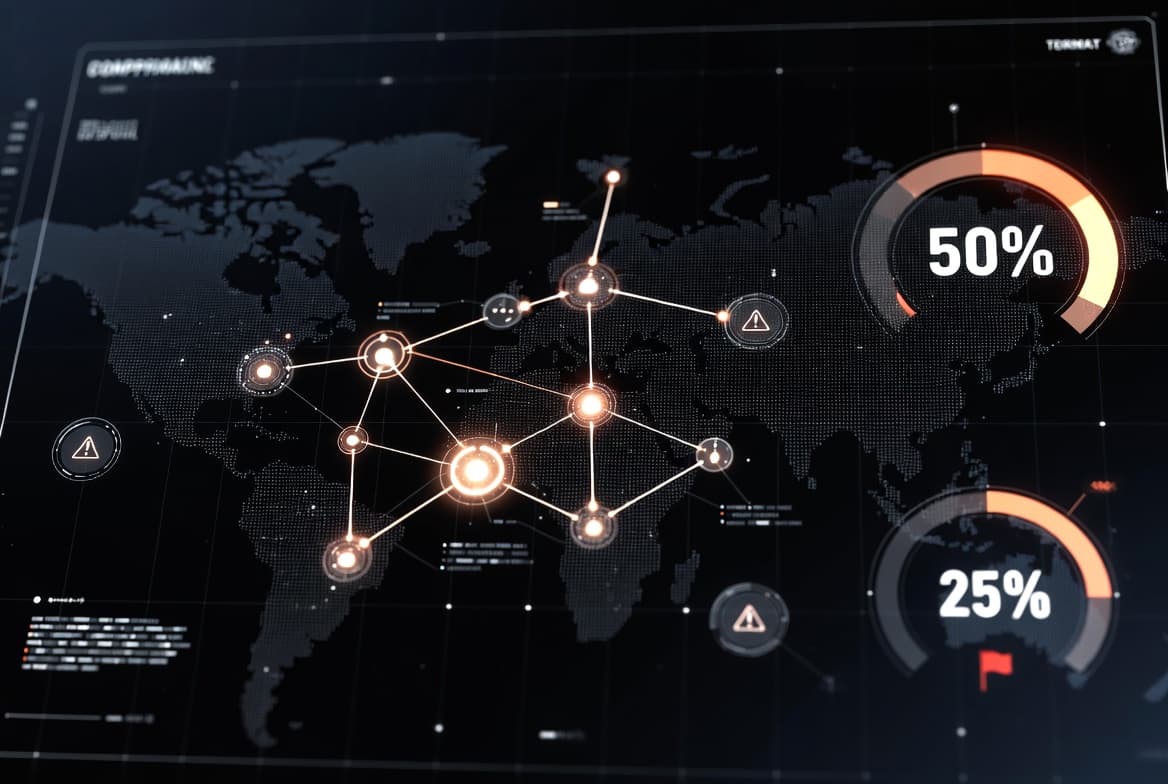
BIS 50% Rule: Ownership Aggregation for Export Compliance
Stop calculating BIS 50% rule ownership in spreadsheets. Get sub-second aggregation results, full ownership chain visibility, and timestamped evidence packs. Join the beta.
If you are still doing 50% math in spreadsheets, you are one ownership update away from a bad day.

It was a normal vendor onboarding. Good website, clean paperwork, solid pricing. They were not on the Entity List, not on the MEU List, and nothing in the initial screening popped.
So the team did what most teams do: they approved the supplier and moved on.
Two weeks later, somebody asked a simple question: “Who owns them?”
That question changed the whole story.
Most screening programs are name-first. You type in an entity name, you check lists, you move on. But the BIS affiliates rule shifts the real risk into ownership and control. That means an entity can look clean by name, while being owned by someone you absolutely cannot touch.
And the kicker is this: the trigger is not only direct ownership. It can be indirect ownership through layers. It can also be aggregate ownership across multiple restricted parties. That is where spreadsheet math starts to break down.
Here is the pattern we see constantly:
Parent company is restricted (on the Entity List or similar).
Subsidiary is not listed by name.
Subsidiary becomes the “front door” for purchasing, sourcing, or contracting.
The business feels safe because the name checks out.
If your workflow stops at list matching leading to a "No Hit", you miss what matters.
Say you have a supplier called “Blue Harbor Components.”
Your screening returns clear. No list hits.
But ownership data shows:
Aggregate restricted ownership.
even if neither owner is a majority by themselves, in aggregate the company is now inside the 50% scope.
Now add one more layer:
Calculation: 60% × 50% = 30% indirect ownership
That one number is easy. The real world rarely is. Real ownership chains look like 4 layers deep, multiple paths to the same parent, partial ownership at each step, and missing slices because nobody has the full picture.
Even when the 50% threshold is not met, significant minority ownership is not “no big deal.” It is a due diligence alarm bell.
Operational Rule: Treat 25% as a serious red flag that triggers extra review. This is not about panic, it is about not being blind.
Aggregate restricted ownership: Block or Escalate
Minority ownership: Red Flag, Due Diligence
Unknown ownership: Red Flag (Unknown is Risk)
And we do not stop at a number. We show the chain. If someone asks “why did we flag this,” you can answer with:
That is the difference between “we think” and “we can prove it.”
If you want to sanity-check a case fast, use our tool. It lets you add owners and percentages, mark restricted parties, see aggregate ownership instantly, and flag minority red flags.
Open CalculatorAsk for parent company, subsidiaries, and major shareholders.
Do list screening, but do not stop there.
Direct, indirect, aggregate. Catch multi-owner math.
50% scope, 25% minority red flag, unknown ownership gaps.
If you cannot prove it later, it did not happen.
Ownership changes, affiliates appear, risk flips overnight.
It is ownership-based scope: if restricted parties own 50% or more of an entity, including through affiliates and aggregate ownership, risk extends beyond the named list entry.
Multiple restricted parties can collectively cross the threshold, even if none individually hits 50%.
Yes, ownership through layers counts, and you multiply percentages along the chain.
A significant minority stake can indicate influence or control risk; it should trigger extra due diligence.
No, a calculator helps you triage and document math, it does not replace legal review.
A quick disclaimer: Educational content only, not legal advice.
Get weekly insights on sanctions, export controls, and visitor compliance delivered to your inbox.
No spam. Unsubscribe anytime.
Related posts
More guidance on sanctions, export controls, and visitor management for regulated facilities.
Stop calculating BIS 50% rule ownership in spreadsheets. Get sub-second aggregation results, full ownership chain visibility, and timestamped evidence packs. Join the beta.

Implement export control checks without slowing operations.